Brick and Janae Meet on the Bus
I'm Still Here- What didn't kill me made me stronger and sharperBrick and Janae Meet on the Bus brings together two strangers carrying danger and loss into the same journey. Brick is leaving Buffalo because he is neither safe nor wanted there; Janae is someone he recognizes from reports and has not yet decided whether to help. Their encounter begins with observation rather than trust: a sketch, a guarded introduction, and the recognition that each has arrived on the bus with a history the other cannot immediately know.
Flight and arrival
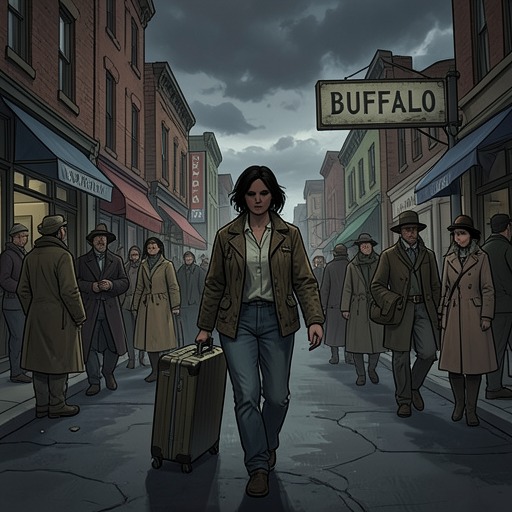
For Brick, the bus journey follows a decisive break with Buffalo. He believes the truth has freed him, but that freedom has not made him safe: there is a price on his head, and he knows he is not wanted in the city. He puts his hoodie over his head, walks to a waiting Liberty taxicab, and chooses California as his destination. He cannot explain the choice beyond a sense that it may be where he needs to go. The decision is therefore both practical flight and an uncertain reach toward somewhere different.
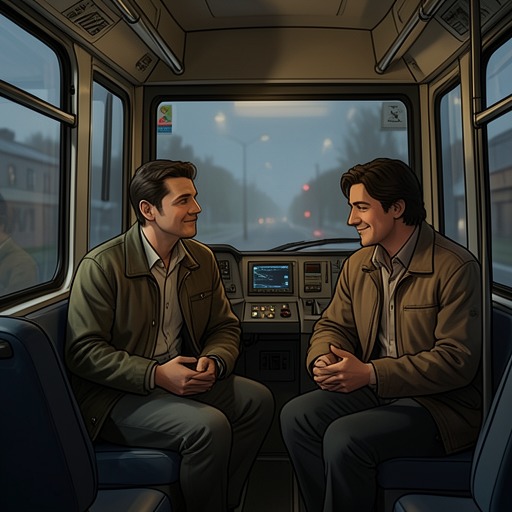
The journey places Brick in the presence of a stranger before either has explained themselves. He sees a very tall, powerfully built man across from him, with milk-chocolate-colored skin and eyes he compares to silver dollars. Wearing red Beats headphones, the stranger listens to The Game and Lil Wayne’s “My Life.” Brick takes out his sketchpad and draws him. The image looks like its subject, but Brick adds two drops to the cheeks even though he has seen no tears. The drawing records what he reads as sadness, while also reflecting the sadness he recognizes within himself. It is an intimate first act of attention, though not yet an exchange of trust.
Janae enters Brick’s attention
Brick’s account then turns to the woman seated beside him. He believes she was supposed to be dead before she boarded and knows her through articles and videos. Those reports have made her seem, to him, like a vulnerable woman entangled with a harmful partner. He has not settled on helping her: he intends to figure her out and determine whether she is someone he should help. His attention is thus divided between suspicion and responsibility, and the decision remains open at the point of their meeting.
The surrounding exchange suggests that someone has arranged for care or assistance. A speaker says, “The council man wife sent me to take care of you.” The evidence does not identify the speaker, so the remark does not by itself establish who made the arrangement or what Brick’s role is in it. It nevertheless introduces an expectation of protection into a scene in which Brick is himself fleeing danger and is still assessing the person beside him.
Names, boundaries, and first contact
Janae responds to an assumed maternal address by correcting it: “Thank you and I am not your Ma. My name is Janae.” Her reply establishes a boundary and gives Brick the name by which she wishes to be known. He observes the roundness of her face, a single dimple on her right cheek, lips glossed with Vaseline, and crinkle curls left by braids. He then extends his hand and introduces himself. The encounter moves from watching at a distance toward direct acknowledgment, but the introduction does not erase the caution with which Brick began.
That contrast gives the scene its shape. Brick initially treats Janae as a figure assembled from public reports, one whose past he needs to investigate before choosing whether to intervene. Her correction makes her a person speaking for herself rather than merely the subject of those reports. His sketch of the stranger has already shown how he gives visible form to sadness; with Janae, the first step is instead a name and a handshake. In both moments, the bus brings him close to people whose circumstances he cannot fully know from appearances alone.
Disclosure and significance
In the conversation associated with their meeting, Janae describes the rejection that shaped her understanding of her own survival. She says her birth mother attempted to end the pregnancy at twenty-six weeks; after the attempt failed, Janae was left unattended, and Grace, the nurse who first cared for her, saved her life. Janae also says that her mother was told she had survived and wanted the staff to let her die. Janae calls her mother her murderer because she feels she has not truly lived, only existed. The account explains why the reports Brick has seen cannot encompass her: the danger attached to her present situation sits alongside a much earlier history of abandonment.
The meeting does not resolve whether Brick will help Janae, nor does the evidence establish that they immediately trust one another. Its importance lies in the opening of that possibility. Brick leaves Buffalo believing truth has brought freedom but not security; he meets Janae while deciding whether to extend care to someone he initially knows only through troubling accounts. Her insistence on her name, followed by her account of survival, shifts the encounter from outside observation toward a more personal understanding. The bus becomes the setting for a tentative connection between two people whose journeys are marked, in different ways, by danger, loss, and the question of whether another person can be trusted.